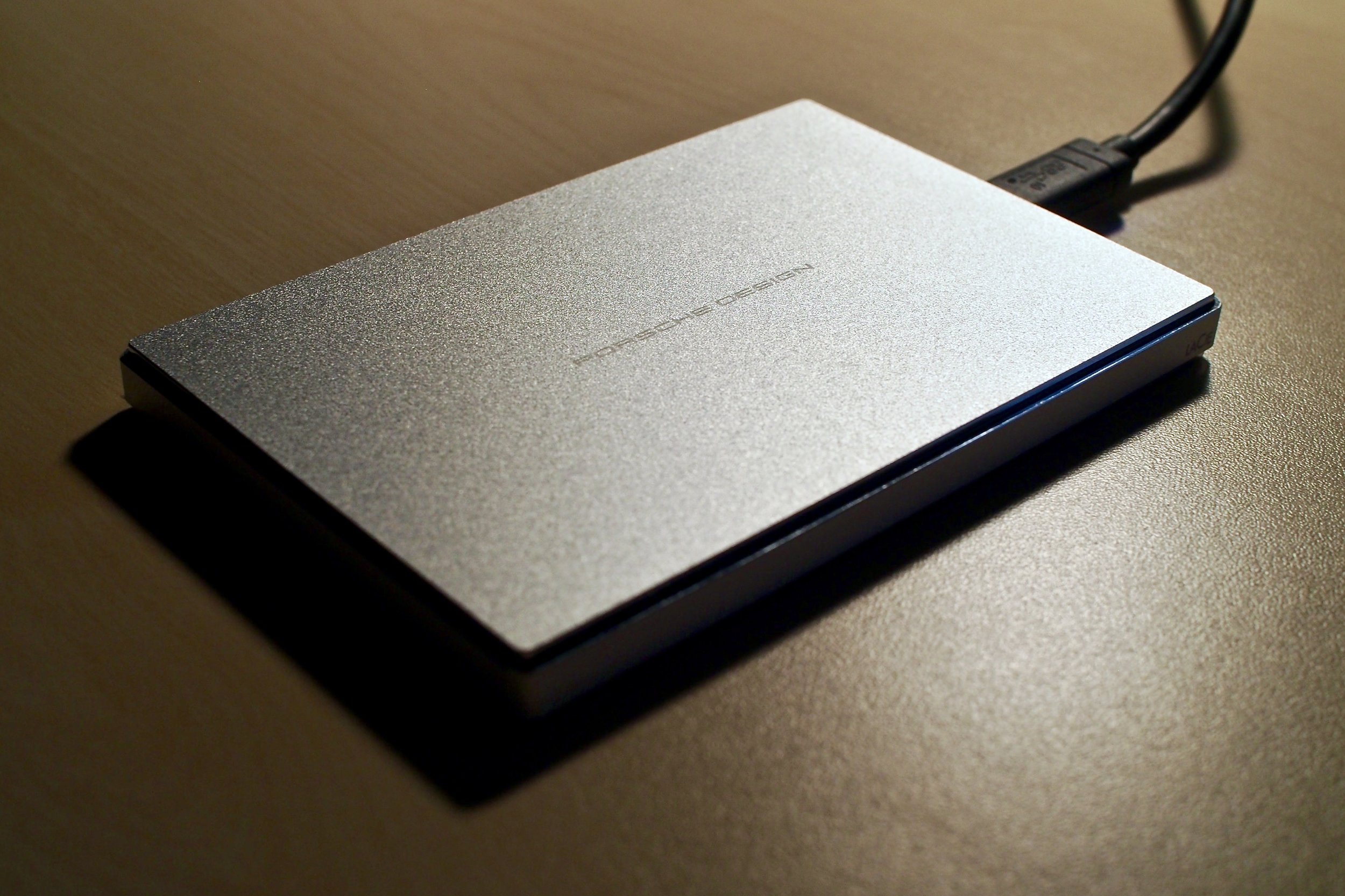
Lacie — Porsche Design Mobile Drive 1TB by Adrian Galli

lacie_mobile_1tb1.jpeg

In film and TV, all of us filmmakers have lots of hard drives and other storage options. My desk, a 72” Mayline drafting table and the main drawer, for big blueprints, is filled with hard drives from many films I’ve worked on.

Frequently, I purchase even more and for a recent project, I needed a drive to work off. The footage did not require anything extensive in the capacity or speed attributes but I do like nice design and I do like reliability.

A good portion of all my drives are Lacie or G-Tech. More times than not, I go for a Lacie Rugged drive (or pair) to take on a shoot. They are hardcore, metal and orange rubber encased hard drives fit for use on location. But, in this scenario, this drive will live on my desk and a bit of beauty is very welcome.

Lacie is no stranger to Porsche Design. I have multiple drives with the Porsche Design moniker but none quite like this. I had not actually seen one of these drives in person—I purchased this drive out of necessity and brand recognition. Lacie has been good to me for over a decade. Only once did a drive fail me and, in actuality, it was the power supply not the storage drive itself. Lacie replaced it and that drive still functions today.

Upon opening the box, I was a bit taken aback. The photography of the product on the box didn’t really do it justice. It seems the metal case with a heavy satin finish and fine polish accent edges is more like something you’d find at Tiffany’s rather than electronics to store data. When I first opened the box I was just eager to plug it in and get thing transferring data but after putting it down, plugging it in, and letting my fingers brush over the surface, I said, under my breath, “wow, this is nice.”

Scientists don’t actually run down the street yelling, “eureka,” when having discovered something amazing. When a scientist says, “huh, how about that…” there is really something profound discovered. I find myself raising one eyebrow like Mr. Spock and simply muttering ‘wow,' having stumbled on a compelling item.

Like my Ray-Ban Aviator review recently, I had not really intended to write a review about the drive—I bought it and was going to use it like I would have some sponges in the kitchen. It was just another hard drive to soak up some data. I went with the Lacie over the G-Drive because the last two hard drives I bought were G-Tech. Otherwise, it was really a 50/50 split as to which one I was going to buy.

Having a hard time finding anything wrong with it, the only two [maybe] negative things I can say: it is a hair louder than the other drives in the same class that I hard. Maybe it is just a higher pitch. I noticed it but only when I was trying to find something wrong with it. When it is in ‘Eco mode’ (energy saving mode) it is silent.

I could not find the RPM specification for the hard drive inside but I would assume it is 5400rpm. There are faster drives out there but this was purchased for price point and function. In other words, maybe it could be faster but for how I will utilize it, I doubt I’ll find the speed to be a problem.

For one terabyte of storage, native USB-C port, 10mm thin, 193g (6.8oz), a bit of shine, and you're looking for a good hard drive that might also have you glancing over at it more like jewelry than a utility for your computer, this is a great choice. There are cheaper hard drives out there but for $75.00 at Apple Michigan Avenue, and a true belief that technology should be as beautiful as art or fine furniture, not much negative can be said about this hard drive.

This little silver brick is rather nice.

Price: $75
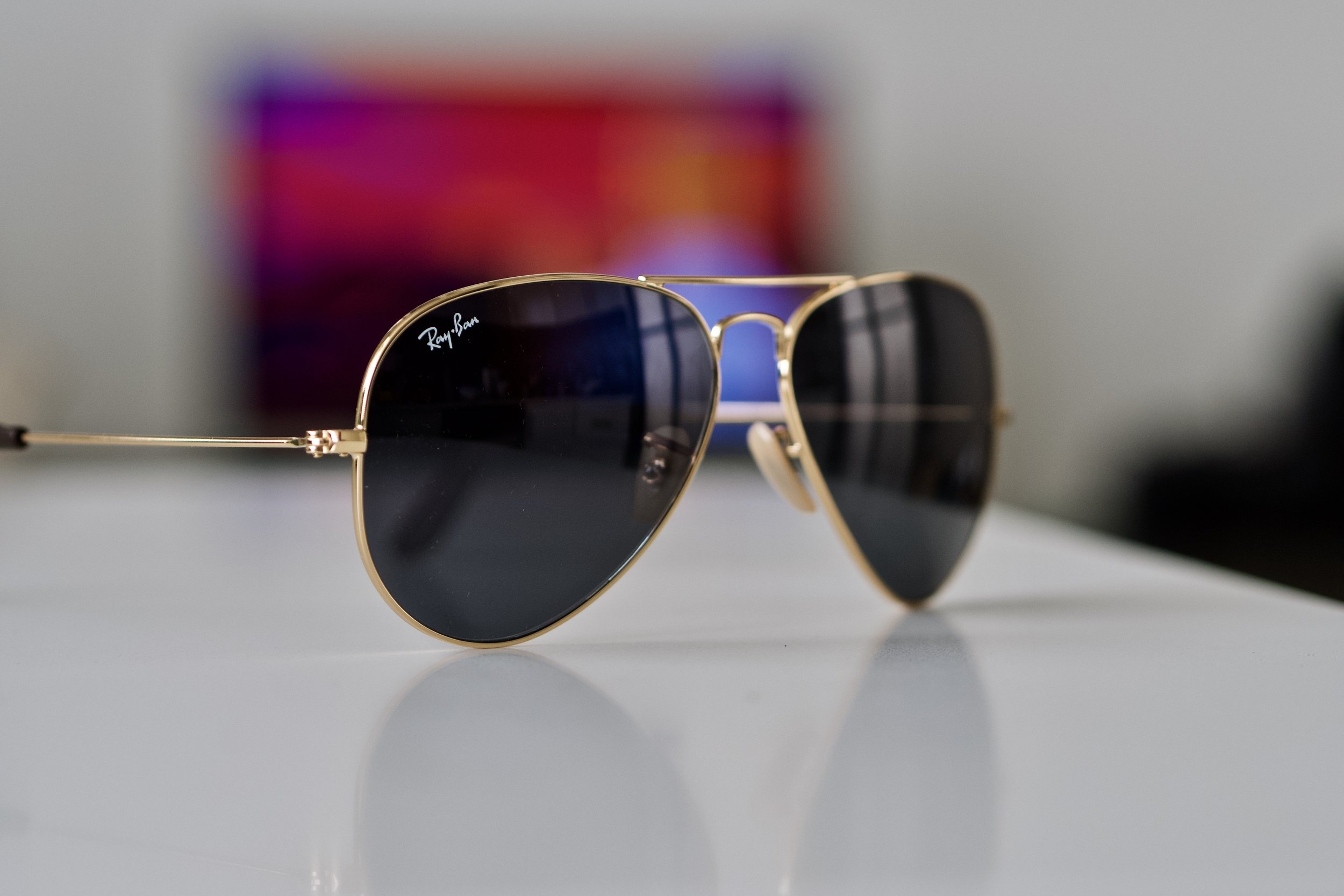
Ray-Ban Aviator @Collection — Gold, Gray/Blue Classic by Adrian Galli

I'm a sucker for badass sunglasses. By far my favorites are aviators and you can't go wrong with a pair of Ray-Ban. They are expensive but with metals frames and glass lenses, many also polarized, one will take extra good care of them when $150 or $200 is dropped.

Meet Ray-Ban Aviator @Collection. They are a special breed of their Aviators and these don't disappoint. The shiny gold frames are very pleasing with a gray/blue lens. I've had my eye on them for sometime.

ray-ban_gray-blue_01.jpeg

I couldn't help but pick these up for my Spring and Summer needs. My images don't do them justice with that blue flair to them but they are a sexy pair of sunglasses. Comfortable and mostly neutral in color reproduction, they might be a touch on the cool (color temperature) side.

In direct sun, there is little lens flare or glare in your eyes and contrast is still very good. These are not polarized but hold their own with reflections. The medium dark is also good for every day use. Even if it is a touch cloudy, they aren't too dark.

This pair also feels a little lighter than my Aviator Flash sunglasses. Not sure why but it is welcome. I've never had a bad pair of sunglasses from Ray-Ban but a little weight off the bridge of one's nose is a plus.

The thing that really catches my attention about these comes from the ever so slight rose tint to the gold frames. That touch of detail in combination with the blue/gray lenses is something that I really love. The colors work really well together and shows attention to detail that makes me love good design so much. 

One thing to note, these sunglasses do not work with Face ID on iPhone X. To be clear, this isn't, and won't ever really be a complaint but just information as Face ID does work with some sunglasses. My Aviator Gold, Yellow Flash sunglasses, for example, do while these do not. 

Only opportunity these sunglasses have, when the inner lenses have any smudges or oil from eyelashes, etc. on them, it tends to be easily visible. While I clean my sunglasses frequently, mostly I don't see these smudges while wearing them. In this instance, and I can only hypothesize it is the coating or the color of the lenses in conjunction with the oils, I see these smudges in my vision. Not a big deal, but something I noticed within a few days of wearing them. However, it only seemed to be visible in direct sunlight.

I rarely do the whole "unboxing video/review" thing... I generally think they are kind of silly (no one cares that you get a warrant card in the box) but I was pleasantly surprised when I opened my package. Ray-Ban added a few fine touches to their @Collection packaging. 

ray-ban_matte_black_01.jpeg

The box itself is a nice matte black—I am a big fan of sleek, simple packaging. Opening the box, I found that the usual case was replaced with a nicer embossed leather case. It's the little things that matter. In fact, honestly, I wasn't even going to write a review about these sunglasses right away but Ray-Ban's extra polish to this experience was so welcome and my new focus on Hexagon + Adrian's Gear relaunch, I waited to even wear them until I had a chance to write this section.

Ray-Bans are great and decently priced compared to some of the sunglasses out there. While that $160 average is a lot to swallow for some, Aviators are classics that will never die. I'll have these sunglasses for a long time. 

Well constructed, adjustments on them for life, glass lenses, and amazing design, this will not be my last pair of Ray-Ban Aviator sunglasses. Many have tried to copy these and make their own versions but Ray-Bans are still the best.

Price: $163

Pro Tip:

If you have an American Express card, check out the offers in their app on online. I got $30 back on this Ray-Ban purchase—second time it has popped up for my card. Definitely take advantage of that little perk.

Nikon D500 Love Story, The Beginning by Adrian Galli

Love at first touch.

fullsizeoutput_4c99.jpeg

My first serious money I spent on a camera was in 2009. I bought a Nikon D700. It is one fine camera even a decade later. This is thanks in part to Nikon’s tireless effort to find some of the best sensors around and build cameras for photographers. It was a $3000 purchase so one would expect it to hold up for some time. Then again, with how quickly technology changes, ten years is a long time.

A testament to its greatness, I actually never upgraded from it. I still shoot with it to this day. In fact, the Nikon D700 is still used by many—it was a camera used for several World Press Photo award winning photographs.

However, anyone who knows or follows me also knows that I really love Micro Four Thirds as a format. My cameras of choice in that family: Olympus E-M5, Olympus E-M1 Mark II. Both rival many cameras of thousands of dollars more. They are small, weather sealed, light, powerful, and fun to use. I recently shot using my Olympus system for a friend’s wedding, iPhone 8 and iPhone X launch at Apple Michigan Avenue, and many of my Geometry photographs were shot using my E-M5 or E-M1 Mark II.

My Nikon digital 35mm (FX) camera, love was never wavering. But the Nikon D700—it is a beast of a camera. Weighing in at nearly 1000g (2.2lbs) without a lens—it is also a boat anchor. I joke with friends and colleagues that I only shoot with it if I’m getting paid. That isn’t entirely accurate… one of my favorite photos, Gold and Aquamarine, was shot with my Nikon D700 and the ever impressive 70-200mm f2.8 VRII.

Gold and Aquamarine, Chicago, 2015

Gold and Aquamarine, Chicago, 2015

The point being, I love Micro Four Thirds and use it because Olympus (among others like Panasonic) have made the system powerful and feature filled yet mobile. I fell in love with the E-M5 and travel with it everywhere. My highest end camera loyalty is, however, really to Nikon. The story of how I came to own my D700 was more like something out of Crouching Tiger, Hidden Dragon. I did not choose the D700, it chose me. I picked it up and couldn’t put it down and that is important. A photographer needs to love his camera. It is a tool and an extension of his creativity and mind’s eye.

The ergonomics of the D700 were so much better than what I was consider buying (Canon 5D Mark II) and its low light noise performance was the best at the time. It didn’t shoot video, like the 5Dmk2 did, but I wanted a camera for photography and owned or had plenty of access to cinema cameras. I never regretted that decision. Even with new cameras, the D700 has been such a creative companion that long after it becomes obsolete, I’ll have it as a token, a monument to years of hard work.

My Olympus, on the other hand, sits right across from me as I write this story. With a grip, fantastic M.Zuiko 45mm f1.8 lens, and a turquoise blue couchguitarstraps strap, it will make its way out into the world soon for some photography. But for now, I needed an upgrade, and something to spark a new creative endeavor.

With 2017 wrapped months ago and A Year in Photographs ended, I had considered for some time what camera it was time to upgrade. Was it time for a D700 replacement? See what Olympus has in store for the O-MD series (E-M5 and E-M1)? 

I don’t know what came over me but I suddenly knew I needed the Nikon D500. Something was telling me it was the right move for a camera. I’ve had my eye on it for some time. But as with my instinct on the D700 drove me to buy and the same with the E-M5, this must be the right move.

Other considerations were the Nikon D810 or newly released D850. I do want to own those but at the end of the day, they are more than I wanted to spend and all that extra resolution is not terribly important to me. They are FX sensors, however and therefore really are the next logical step to a D700. 

Some have asked, “Why not a D750?” To be fair, having intimate experience with the D700 and D810, the D750 may have the ‘700’ numerical value but it is not the replacement to the D700. The D8XX has the same feel, look, weight, and powerhouse features that the D700 did in its day. As a comparison, in 2009, the D700 was the flagship, non-integrated vertical grip, FX camera for Nikon. Today the D8XX is the same. The D750 is a superb camera but maybe one small step below.

The Nikon D500 has been reveled as the best APS-C (DX). Its high-ISO performance is stunning. Its 10 frames per second puts it in a class similar to a Nikon D4 but with the resolution for the Nikon D5 (the ultimate in Nikon performance.) And that is part of the D500’s charm. How could I turn my back on FX sensors? They are superior because they are bigger! I have always argued that is a false assumption. It is a good rule of thumb but not a guarantee. Your lens is your most important camera accessory but that is for another article.

Nikon has made the D500 is in the class of FX cameras. In fact, the performance is likely partly due to the DX sensor. While sensors of different sizes have their advantages and disadvantages, at the end of the day, I’ve shots with more than a dozen formats and it is, overall, a non-issue. FX, DX, Micro Four Thirds, 1/2”, 2/3”, super35, medium format, iPhone, 1-inch, etc.—let me tell you something, and I’m not going to apologize for it, the sensor behind your lens does not determine anything. You do. You are the photographer. Any other argument is a construct of your mind—dogma from a thousand other photographers out there who can’t see beyond the technical specifications of the camera in their hand.

 
Don’t be trapped by dogma—which is living with the results of other people’s thinking.
— Steve Jobs
 

If you can’t afford a Nikon D850 (or just don’t want to move that kind of cash) don’t. Get a Nikon D500. Or a D7200. Or a D3400 (it’s around $400). Or use your iPhone. Just go out and shoot!

I choose the D500 for a good price point, blistering performance on multiple fronts, and knowing that it will be a workhouse. Correction, a god damned battleship of a camera. I will be able to take it out in the rain, walk through the desert with it, a blizzard, concerts, film shoots, in the air, underground, all over the planet, drag it through the mud, and it will still fire and capture exactly what I see just as my D700 did for nearly ten years.

As I write this, I pick up my D500 for the first time and already recognize, I’m gonna love this camera.

Price: $1896